

Marc Vidal y la revolución industrial: sin miedo y con criterio
The main takeaway from our conversation with Marc Vidal is clear: artificial intelligence is the engine of a new industrial revolution, and SMEs can jump on board without fear, as long as they keep their wits about them.
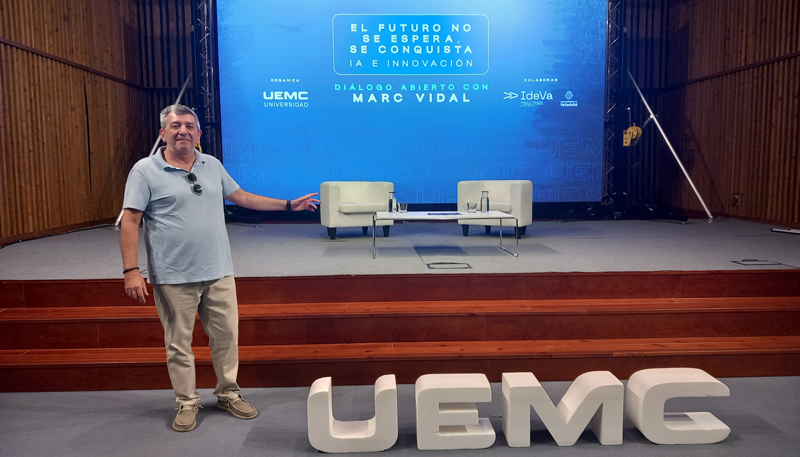
On 1 October, the Altira Automations team attended the open dialogue «The future isn't waited for, it's conquered. AI and Innovation» at the Paraninfo of the European University of Miguel de Cervantes (UEMC). The event brought together around 300 people and representatives from a hundred companies in Castile and León, with journalist Antonio Renedo acting as moderator.
The event was part of Campus Innova-Sostenible, a UEMC project with the Valladolid City Council through IdeVa, its innovation agency. These are the ideas that gave us the most food for thought and what, in our opinion, they mean for an SME.
An industrial revolution, not a fad
Marc Vidal presented AI as the tool of a new industrial revolution. And not a partial revolution either: in his view, it transforms how we understand our customers, what services we offer, our business models and the way we organise our company.
We particularly liked one idea: often it’s not what we sell that changes, but how we sell it. For an SME, this is great news. You don’t need to reinvent your business to make the most of AI; you just need to do what you already do well, better.
Vidal also compared this moment to the arrival of the internet. Thirty years ago, some companies doubted whether they needed it. Today, nobody questions it. The same thing will happen with AI: the question is not whether it will reach your business, but whether you will reach it before your competitors do.
No fear, but with sound judgement
You often hear that AI is going to wipe us out before 2030. Marc Vidal encouraged us not to be afraid, and we agree: fear paralyses, and a paralysed SME gets left behind.
But having no fear doesn’t mean leaving everything in the hands of the machine. Vidal insisted that professionals will need to engage in continuous learning and develop critical thinking, judgement and interpersonal skills. He even suggested that, before long, working will look increasingly like learning.
At Altira we see it every day: AI isn't here to make decisions for anyone, but to help us make better ones. Repetitive tasks are handled by technology; judgement remains in human hands.
The open door: responsibility is human
One of the most interesting moments came when discussing risks. For Marc Vidal, AI cannot be inherently bad; at worst, it is the person setting it in motion who is. He summed it up with a very graphic image: if AI does something wrong, «it’s because someone left a door open for it and someone told it to walk through».
Behind many data leaks or misuse, there isn’t a rogue machine, but a poorly designed process, a careless password or a decision that nobody reviewed. That is why Vidal reminded us of something simple and very useful: check and verify what AI tells us.
It is precisely the principle we work by at Altira. None of our automations make important decisions without a human giving the green light. Not out of distrust towards technology, but because responsibility ultimately always rests with humans.
Where we differ: clear rules that breed confidence
There was one point where we see things somewhat differently. Marc Vidal warned that there are interests fuelling the fear of AI to demand that it be slowed down or regulated, and that this could hinder its evolution. To explain this, he gave an example: if someone had regulated electricity before knowing its full potential, perhaps today we wouldn't have plug sockets or light switches.
We share his rejection of fear as an argument. But we would like to spin his own example slightly: today we use electricity every day without a second thought precisely because there are regulations that make electrical installations safe. Nobody would install a plug socket without them.
With AI, an SME needs something similar to take the plunge: knowing that its data and its customers' data are protected and that no one is going to make decisions on its behalf without oversight. That is why at Altira we work in compliance with the European AI Act and the GDPR. For us, clear rules don't hold AI back; they generate the confidence that many companies need to start using it.
What it means for an SME in Valladolid
Marc Vidal spoke about Valladolid's potential if it connects sectors such as automotive, logistics, technology and agri-food. That transformation isn't just for large companies. Today, with AI, an SME can automate tasks that previously required an entire team and compete with much larger businesses.
The industrial revolution isn't won all at once, but step by step. Our recommendation on how to start:
- Choose a single repetitive task that currently takes up your time: quotes, invoices, appointments or customer replies.
- Automate it with a human at the helm to review and approve everything before it reaches the customer.
- Train your team on that real automation, so they know how to handle and improve it without depending on anyone else.
- Measure the result in hours recovered and errors avoided, and then decide on the next step.
The future is conquered, but with humans at the helm
We left the UEMC with the feeling that the event’s title was spot on: the future isn't waited for, it's conquered. And in this new industrial revolution, conquering it means using AI without fear, with sound judgement and with clear rules.
We would like to thank the UEMC, the Valladolid City Council and IdeVa for organising an event that connects academia, business and technology, and Marc Vidal for sharing ideas that give plenty of food for thought.
Want to find out what could be automated in your business? Book a free 15-minute call, with no obligation.
Want to apply this to your business?
Tell us what you'd like to automate. 30 minutes, no obligation, to see if we can help.